
Middle East Conflict Forces Gulf Pharma Supply Chains to Reroute via Saudi Arabia
By Abdulrazaq Auwal
The ongoing conflict in the Middle East has sent shockwaves through pharmaceutical supply chains across the Gulf.
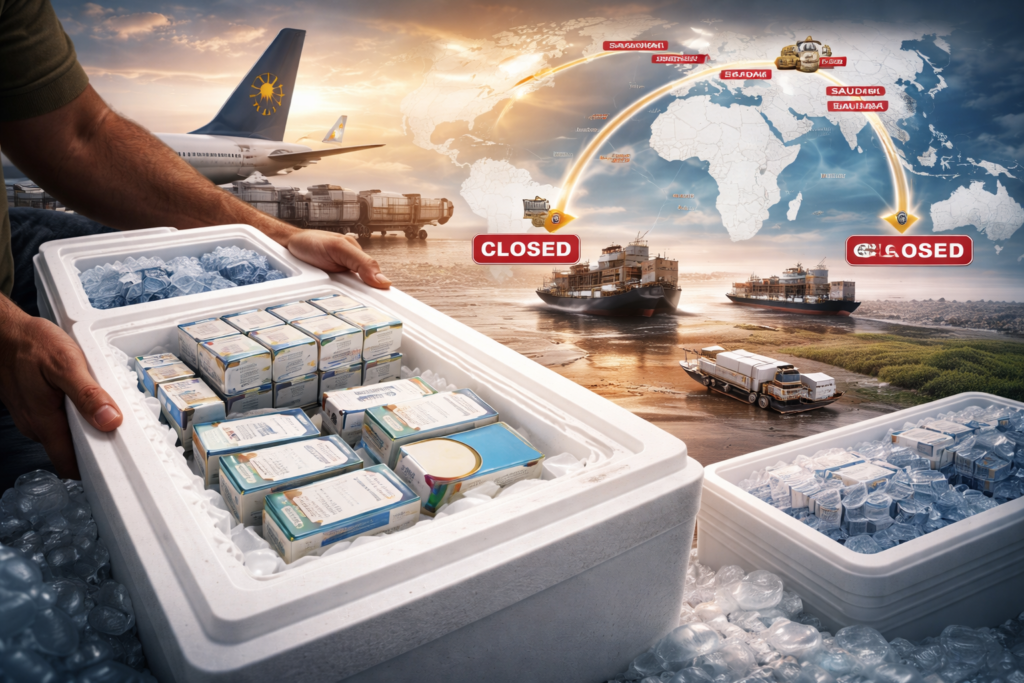
The event has so far forced companies to reroute shipments of critical, temperature-sensitive medicines, including cancer treatments, as key air and sea transit hubs are knocked offline.
The disruption stems from a series of military strikes involving the United States, Israel, and Iran, which have closed major airports in Dubai, Abu Dhabi, and Doha.
These hubs traditionally handle large volumes of refrigerated pharmaceuticals through carriers such as Emirates and Etihad, as well as logistics firms including DHL.
Additionally, the closure of the Strait of Hormuz has rendered sea routes impractical, extending transit times and complicating deliveries of life-saving medicines.
Industry experts warn that the scale of disruption is significant. Wouter Dewulf, professor at Antwerp Management School, notes that over 20% of global air cargo, primarily used for critical drugs and vaccines is exposed to the interruption.
Pharmaceutical companies are responding by rerouting shipments to alternative hubs in Saudi Arabia, including Jeddah and Riyadh, as well as Istanbul and Oman, and using overland transport to reach final markets.
Europe-to-Asia cargo previously transiting through Dubai or Doha is now being redirected through China or Singapore.
READ ALSO: https://hajjgazette.com/breaking-uae-temporarily-closes-airspace-over-safety-concerns/
Companies are deploying internal teams to prioritize patient-critical shipments and relying on dry ice to maintain cold-chain integrity, increasing both cost and logistical complexity.
Medicines requiring strict refrigeration and those with short shelf lives, especially oncology drugs such as monoclonal antibodies face the highest risk.
Experts warn that Gulf stock levels of these medicines, typically covering three months of demand, could be depleted within four to six weeks if the disruption continues, raising serious implications for patients’ treatment outcomes.
Amid this uncertainty, Saudi Arabia has emerged as a stabilizing force in the region. Airports in Jeddah and Riyadh are now serving as primary logistics hubs, enabling the continued delivery of critical medicines.
The Kingdom is also providing broader humanitarian support through the King Salman Humanitarian Aid and Relief Centre (KSrelief), supplying medical aid to conflict-affected areas including Gaza, Lebanon, and Sudan.
Logistics leaders emphasize that while alternative corridors are holding, constant management is required as the conflict evolves.
Saudi Arabia’s infrastructure and operational stability have proven crucial in maintaining regional access to essential pharmaceuticals, effectively positioning the Kingdom as a lifeline for the Gulf during this period of unprecedented supply chain disruption.