

What Actually Happens to Jamarat Stones After Hajj
By Abdulrazaq Auwal
One of the most iconic rituals of Hajj is the stoning of the Jamarat, performed by pilgrims at Mina following wukuf at Arafah and Mabit at Muzdalifah.
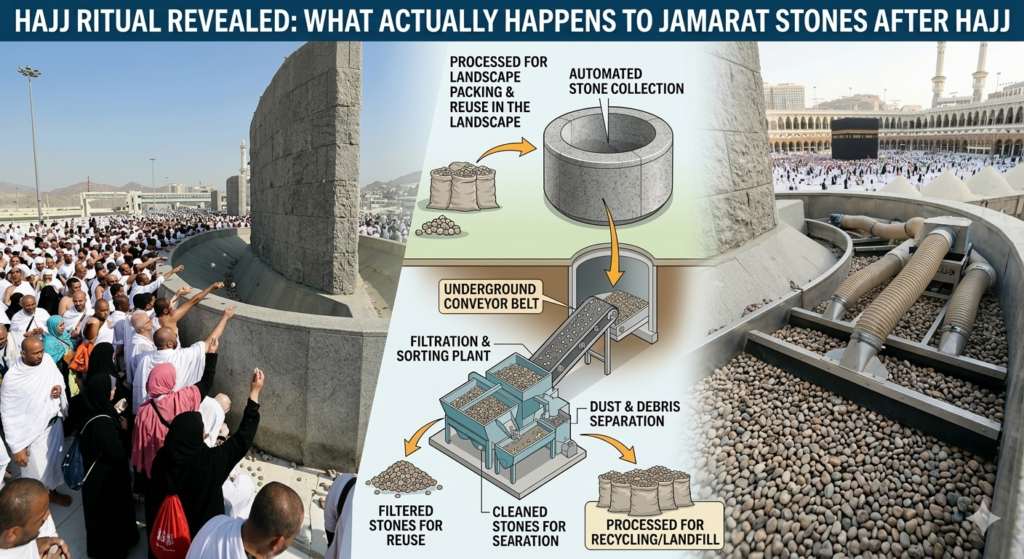
While millions participate in this symbolic act every year, many have long wondered what happens to the pebbles after they are thrown, especially within the multi-story Jamarat facility, where stones fall across three pillars and up to four floors deep, reaching a depth of 15 meters.
Speaking to the Saudi Press Agency (SPA), Ahmed Al-Subhi, an employee of Kedana Company, explained that the process of handling the pebbles begins immediately after the stoning ritual on the first, second, and third days of Hajj.
“Pebbles that accumulate in the basement of the Jamarat facility are collected by conveyor belts, transported to a sieving station, and sprayed with water to remove dust and dirt,” Al-Subhi said.
“After cleaning, the stones are transferred to vehicles and stored for further handling once the Hajj season concludes,” he added.
READ ALSO: https://hajjgazette.com/7-things-women-must-avoid-while-in-ihram-during-hajj-or-umrah/
He noted that the volume of pebbles is immense, reflecting the millions of pilgrims who participate each year.

The organizations responsible for managing the stones, Hidayah-Haji and Mu’tamer Gift, in collaboration with Kedana Company have implemented this process as part of an initiative to improve services at the Holy Sites. According to official figures, Jamarat gravel can reach up to 1,000 tons annually.
Once the season ends, the cleaned gravel is packed into small bags. In 2025, over 83,000 bags were redistributed across 300 contact points along the Muzdalifah walking route.
The initiative ensures that prospective pilgrims can access the stones for future Hajj seasons, while also alleviating the logistical burden on current pilgrims during the stoning ritual.

“This system is designed not only to manage the large volume of pebbles efficiently but also to enhance the experience of pilgrims performing one of the most important rites of Hajj,” the organization confirmed.