

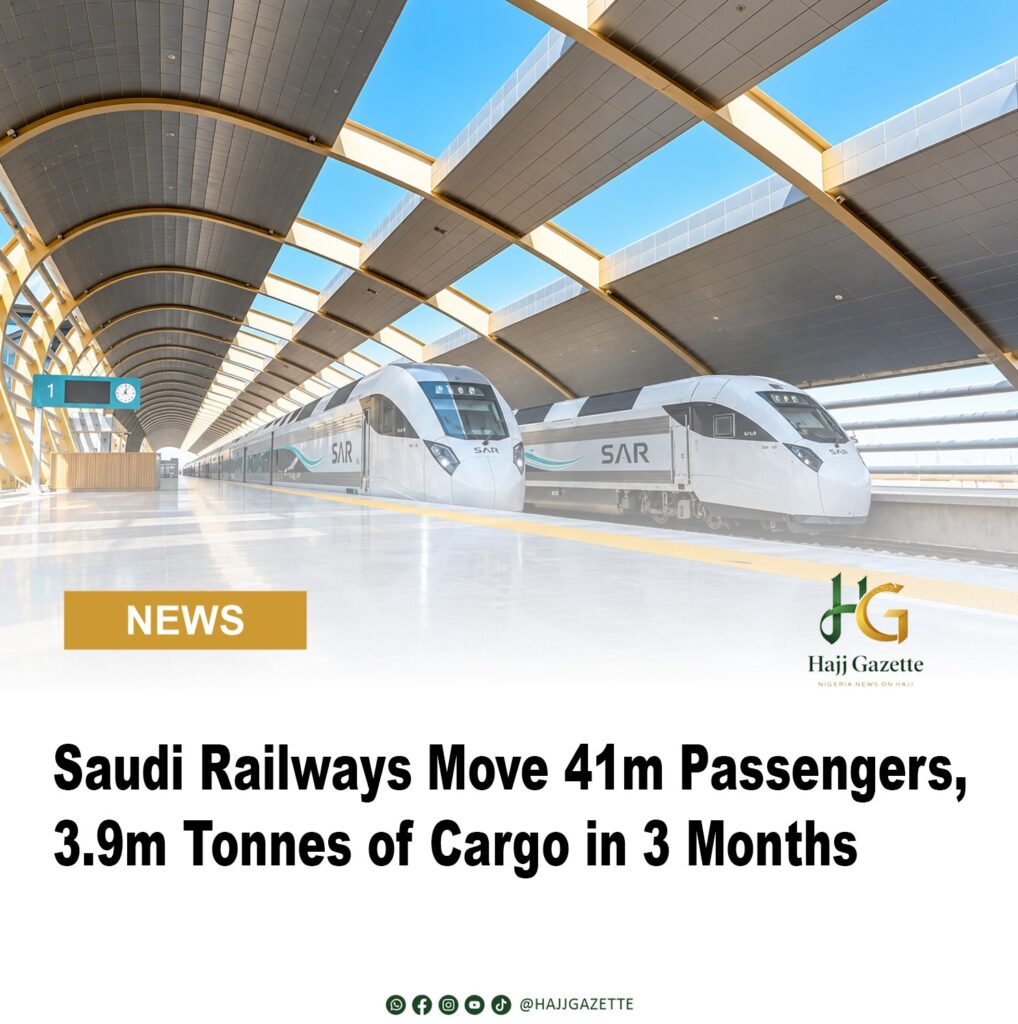
Saudi Railways Move 41m Passengers, 3.9m Tonnes of Cargo in 3 Months
By Abdulrazaq Auwal
Saudi Arabia’s railway network transported more than 40.9 million passengers and 3.9 million tonnes of freight in the third quarter of 2026, highlighting the growing role of rail transport in the Kingdom.
The figures were contained in a quarterly report released by the Transport General Authority (TGA), which also recorded the movement of 46,300 containers between July and September.
Intra-city rail services accounted for 38.3 million passengers, with the Riyadh Metro carrying the largest share at 30.4 million.
The King Abdulaziz International Airport Automated Train transported seven million passengers, while the Princess Nourah bint Abdulrahman University line recorded approximately 911,200 passengers.
Intercity rail services carried more than 2.5 million passengers during the three-month period.
The Haramain High Speed Railway, which connects Makkah and Madinah through Jeddah, King Abdulaziz International Airport and King Abdullah Economic City, transported more than 1.9 million passengers.
Saudi Railways Move 41m Passengers, 3.9m Tonnes of Cargo in 3 Months
The Eastern Network, linking Riyadh, Abqaiq, Hofuf and Dammam, carried approximately 393,900 passengers, while the Northern Network, connecting Riyadh with Al-Majmaah, Qassim, Hail, Al-Jouf and Al-Qurayyat, recorded 258,600 passengers.
The latest figures follow a significant increase in railway patronage in 2025, when Saudi Arabia recorded approximately 156.4 million rail passengers, up 266.5 per cent from 42.7 million in 2024, according to the General Authority for Statistics (GASTAT).
Intracity railway passenger numbers rose by 368 per cent to 145.4 million in 2025, while intercity passenger numbers fell by 5.6 per cent to 10.9 million.
Saudi Arabia’s railway network also transported 16.1 million tonnes of freight in 2025, with the Northern Network accounting for 89.7 per cent of the total.
The figures underscore the growing importance of rail infrastructure to passenger mobility and freight distribution as Saudi Arabia continues to expand its transport network.