

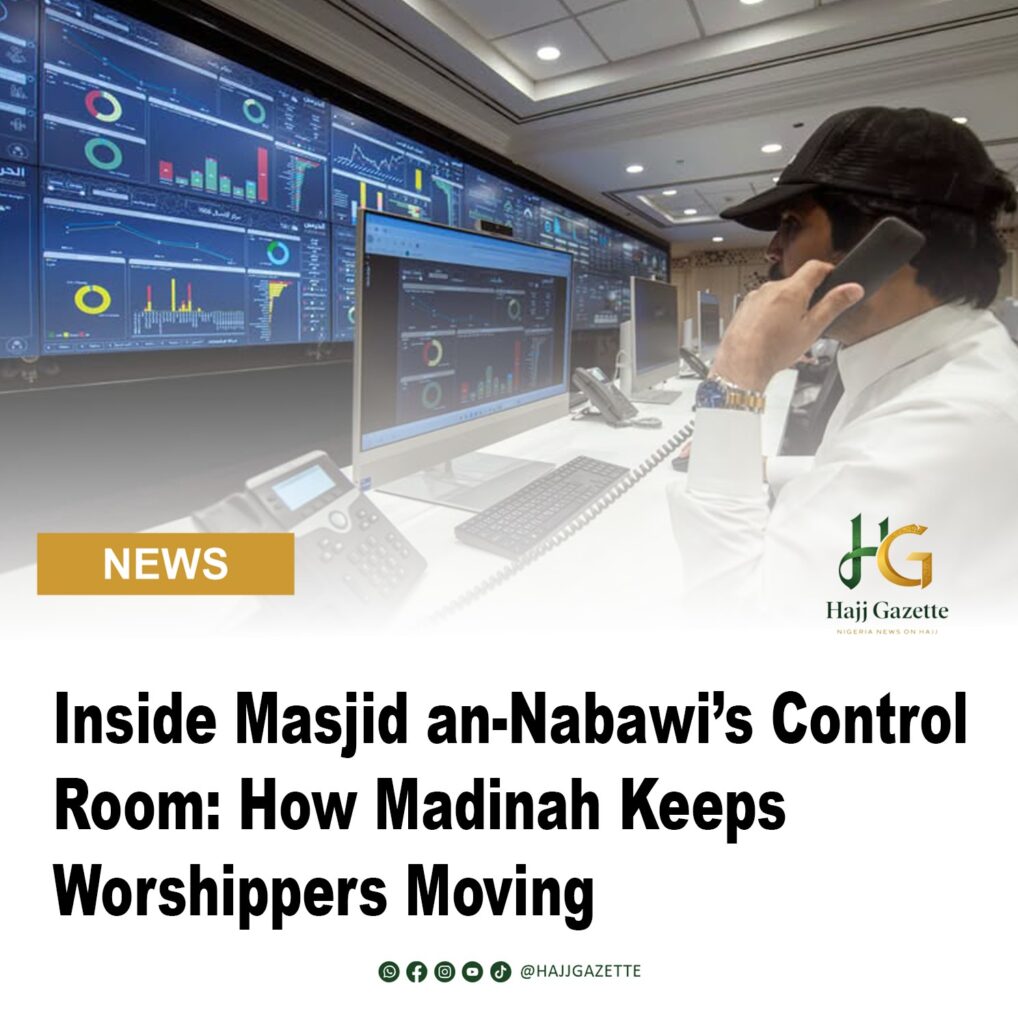
Inside Masjid an-Nabawi’s Control Room: How Madinah Keeps Worshippers Moving
By Abdulrazaq Auwal
Before the imam ascends the minbar for Friday prayers at Masjid an-Nabawi, a vast operation is already underway, one that largely remains invisible to worshippers but keeps hundreds of thousands of people moving safely and orderly.
Behind the calm appearance of the Prophet’s Mosque and its expansive courtyards is a security and operations system built around continuous monitoring, field coordination and crowd-flow management.
At the centre is the Security Operations Center, which Saudi authorities say uses advanced technology to monitor worshipper movement and manage crowds inside the mosque and surrounding courtyards.
Saudi Interior Minister Prince Abdulaziz bin Saud bin Naif inspected the centre in May 2025, as officials briefed him on its functions and technological capabilities. On a busy Friday, the challenge begins long before prayer.
Worshippers arrive in waves, heading towards prayer areas, entrances, exits, courtyards and the Al-Salam Corridor, where visitors convey greetings to the Prophet Muhammad and his two companions.
To prevent congestion at one point from disrupting the wider movement, Saudi authorities use designated pedestrian routes, controlled crossing points, directional signs and field teams to regulate movement, particularly during peak periods.
Inside the mosque, prayer areas are prepared ahead of time while corridors and movement routes are kept clear to maintain pedestrian flow and emergency access.
The operations centre does not work alone. Its effectiveness depends on connecting information with personnel on the ground.
Field teams operate continuously across the mosque and courtyards, providing directions and assistance, supporting all visitors, and helping manage crowd movement.
Inside Masjid an-Nabawi’s Control Room: How Madinah Keeps Worshippers Moving
During the first Friday prayer after Hajj in June 2026, the Saudi Press Agency reported that security aviation sorties monitored crowd and visitor movement before and after prayers.
The aerial support helped authorities identify high-density areas and coordinate responses among agencies.
Technology is also giving worshippers more information before they enter crowded areas.
The Prophet’s Mosque provides a digital prayer-area occupancy service showing real-time information on available spaces across major sections, including expansions, the roof and western courtyards.
Colour-coded indicators help visitors identify areas with available capacity. A separate system allows visitors to check crowd density along the Prophet’s greeting corridor, helping distribute demand and reduce sudden concentrations.
The principle is straightforward: manage congestion before it becomes an emergency.
When one area becomes crowded, authorities can redirect worshippers, adjust pedestrian flows, deploy personnel and keep critical routes open rather than waiting for dangerous crowding to develop.
Saudi Arabia is also expanding artificial intelligence and advanced analytics across its wider pilgrimage-management system.
During Hajj 2026, the Sawaher platform used more than 5,000 cameras, 31 dashboards and 16 AI algorithms across 80 locations to support crowd management.
That system should not, however, be assumed to be the same technology used by the Prophet’s Mosque operations centre.
For worshippers, the result may appear simple: a clear passageway, a redirected crowd, an officer pointing towards another entrance or a digital display showing available prayer space.
Behind those seemingly ordinary interventions is a system built around information, coordination and timing.
And during Friday prayers, when visitor numbers surge and the margin for error narrows, that invisible coordination becomes critical.
At Masjid an-Nabawi, the most successful crowd-management operation may ultimately be the one worshipper barely notice.