
Faith and Discipline: Why Daily Prayers Emerge as the Most Demanding Pillar of Islam
By Abdulrazaq Auwal
A growing body of scholarly reflection and community discourse suggests that while the Five Pillars of Islam form a unified framework of worship, the practical demands of each pillar vary significantly, placing daily prayers, known as Salah, at the center of the most sustained personal challenge for many Muslims.
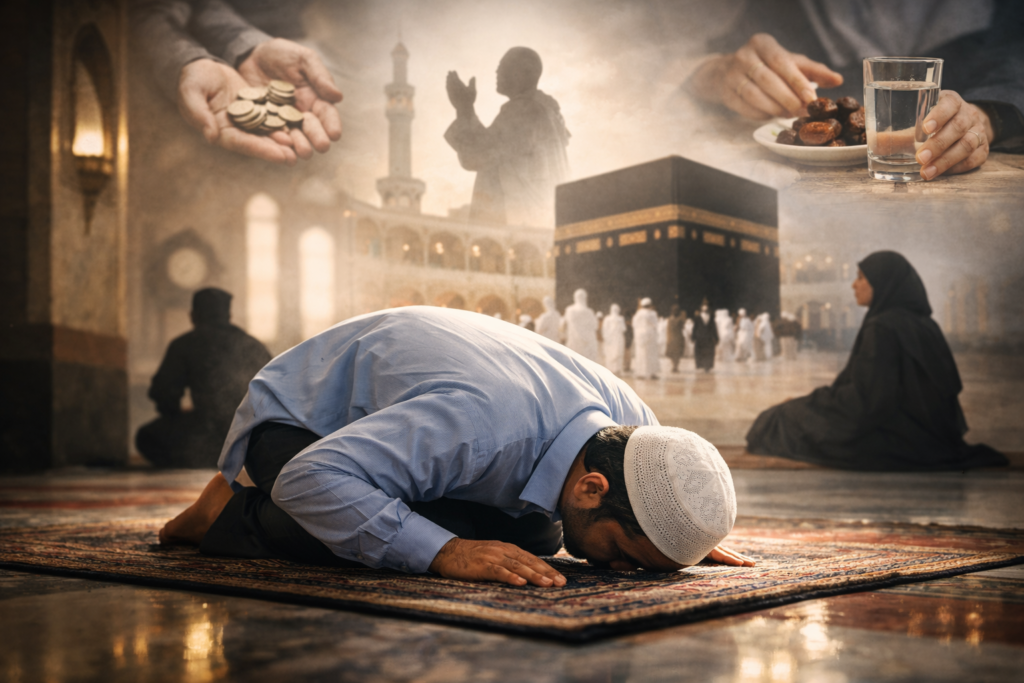
The Five Pillars; Shahādah (declaration of faith), Salah (five daily prayers), Zakah (obligatory charity), Sawm (fasting during Ramadan), and Hajj (pilgrimage to Makkah), are universally recognized as the foundation of Islamic practice.
However, religious scholars emphasize that Islam does not rank these pillars by difficulty, as each is structured around individual capacity and accountability.
READ ALSO: https://hajjgazette.com/gombe-pilgrims-board-to-resumes-bita-program-for-2026-hajj/
Experts note that Salah stands out due to its continuous nature. Unlike other pillars that are periodic or conditional, the obligation to perform five daily prayers requires consistent time management, discipline, and spiritual focus throughout a Muslim’s lifetime.
“It is the only pillar that structures a believer’s day from dawn to night, without exemption except under specific conditions,” a cleric explained.
In contrast, Sawm, observed during the holy month of Ramadan, is widely acknowledged as physically and mentally demanding. However, its time-bound nature and the communal environment in which it is practiced often provide a support system that mitigates its difficulty.
Similarly, Hajj; the annual pilgrimage to the holy city of Makkah presents logistical, financial, and physical challenges.
Yet, it is required only once in a lifetime and only for those who possess the means and health to undertake the journey.
Zakah, on the other hand, is tied to financial capacity, making it situational. While it tests a believer’s willingness to part with wealth, it is not universally applicable to all Muslims.
Meanwhile, Shahādah, the declaration affirming the oneness of Allah and the prophethood of Muhammad (peace be upon him), is considered the simplest in articulation but the most profound in lifelong commitment.
Religious analysts maintain that framing one pillar as “most difficult” may oversimplify a system designed for balance and accessibility.
Instead, they argue that the variation in demands reflects Islam’s broader principle of flexibility, ensuring that obligations align with individual circumstances.
Nonetheless, across diverse communities, Salah continues to be widely regarded as the most consistently challenging in practice requiring unwavering commitment in both routine and devotion.