

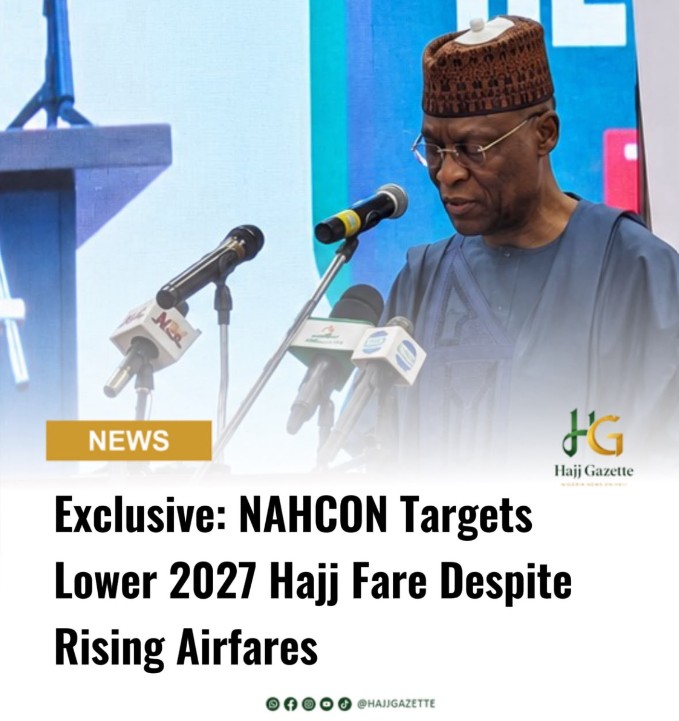
Exclusive: NAHCON Targets Lower 2027 Hajj Fare Despite Rising Airfares
By Abdulrazaq Auwal
The National Hajj Commission of Nigeria (NAHCON) has unveiled practical measures aimed at reducing the cost of the 2027 Hajj despite mounting global aviation costs, assuring intending pilgrims that it remains committed to maintaining quality services while pursuing more affordable pilgrimage packages.
Chairman and Chief Executive Officer of NAHCON, Ambassador Ismail Abba Yusuf, disclosed the strategy in an exclusive response to Hajj Gazette, explaining that the Commission had already commenced early assessments of hotels and catering facilities in Makkah and Madinah to secure competitive rates before Saudi Arabia’s September 29, 2026 deadline for finalizing service arrangements.
According to him, airfare remains the single biggest component of the Hajj fare, driven largely by the rising global cost of aviation fuel, a factor beyond the Commission’s control.
“The costliest component of the Hajj fare is air ticket. This has globally gone up exponentially due to the rising cost of aviation fuel, over which NAHCON has no control,” he said.
He added that NAHCON is engaging the Saudi Ministry of Hajj and Umrah to negotiate reductions in Masha’ir service charges covering tents, transportation and accommodation in Mina and Arafat, while early hotel and catering assessments are expected to prevent last-minute price hikes.
Exclusive: NAHCON Targets Lower 2027 Hajj Fare Despite Rising Airfares
Analysts note that air transport typically accounts for a substantial share of Nigeria’s Hajj package, alongside accommodation, feeding, transportation and other mandatory services in Saudi Arabia.
In recent years, fluctuations in foreign exchange rates and aviation fuel prices have significantly influenced Hajj fares worldwide.
The NAHCON boss stressed that the Commission would not compromise service quality in its quest to reduce costs, recalling that during the 2026 Hajj it rejected substandard meals and secured refunds from service providers to protect Nigerian pilgrims.
He, however, emphasized that achieving better pricing would depend largely on early registration and payments by intending pilgrims, enabling the Commission to conclude contracts ahead of Saudi deadlines and negotiate more favorable rates.