

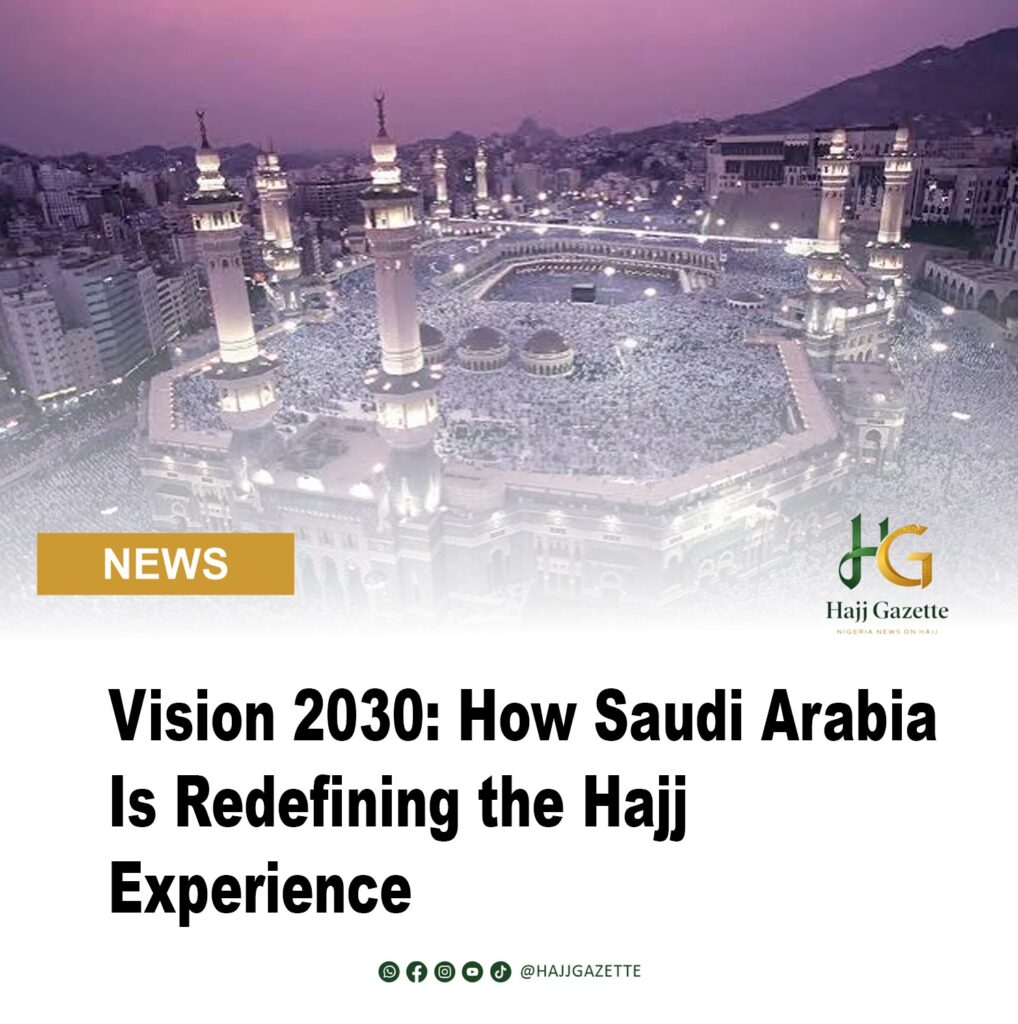
Vision 2030: How Saudi Arabia Is Redefining the Hajj Experience
From smart technology and integrated operations to safety, efficiency and dignity in the sacred journey
By Muhammad Bello Abdullahi
The annual Hajj pilgrimage is one of the world’s most complex logistical and spiritual undertakings. Millions of Muslims from different countries, languages and cultures converge on Makkah and the holy sites to perform the same sacred rites within a relatively short period.
Managing such a vast gathering requires far more than expanding infrastructure. It demands meticulous planning, seamless coordination, advanced technology, operational discipline and an unwavering commitment to protecting the safety, wellbeing and dignity of every pilgrim.
It is against this backdrop that Saudi Arabia’s Vision 2030 has assumed growing significance in the transformation of Hajj administration and pilgrim services.
The objective extends beyond modernising the physical environment surrounding the pilgrimage. It is about building an increasingly integrated system capable of making Hajj safer, more efficient, better coordinated and more responsive to the needs of pilgrims.
Ultimately, the measure of this transformation should be simple: whether the systems being developed make it easier for pilgrims to perform their religious obligations safely and peacefully.
From infrastructure to integrated Hajj management
Over the years, Saudi Arabia has invested substantially in expanding the capacity of the holy sites, improving roads and transportation networks, developing accommodation facilities and strengthening healthcare, security and emergency services.
But modern Hajj management increasingly depends on how effectively these systems work together.
Transportation must be coordinated with accommodation. Crowd movement must be integrated with security and emergency-response systems. Health services must be positioned according to changing patterns of pilgrim movement. Information must reach pilgrims quickly and in languages they understand.
The objective is therefore not simply to build more infrastructure, but to create an integrated Hajj ecosystem in which different services operate as parts of one coordinated system.
Such integration can reduce confusion, improve response times and allow authorities to identify and address operational challenges before they develop into serious disruptions.
Technology at the heart of transformation
Technology has become an increasingly important component of Hajj operations.
Vision 2030: How Saudi Arabia Is Redefining the Hajj Experience
Digital services, electronic identification, smart transportation systems, data analytics and real-time monitoring are changing the way authorities manage the movement and services of millions of pilgrims.
For pilgrims, the benefits can be practical and immediate. Digital platforms can provide information on transportation, accommodation, schedules, healthcare and other essential services, reducing the uncertainty that can accompany travel through unfamiliar environments.
More importantly, technology creates the possibility of moving Hajj management from a predominantly reactive model to a more predictive one.
Data collected from transportation networks, crowd movements and other operational systems can help authorities anticipate potential bottlenecks, identify emerging risks and deploy resources before problems escalate.
But digitalisation should not become an end in itself. Technology is valuable only when it improves the experience of the person at the centre of the entire system—the pilgrim.
Safety must remain the first priority
No reform of Hajj administration can be considered successful unless it strengthens pilgrim safety.
The concentration of millions of people within relatively limited spaces creates unique operational challenges. Extreme heat, fatigue, congestion, medical emergencies and transportation difficulties can quickly become serious risks.
Vision 2030 provides an opportunity to bring infrastructure, technology, emergency services, healthcare and crowd-management expertise together within a comprehensive safety framework.
However, safety also depends on continuous learning.
Every Hajj season provides new operational data and lessons. Authorities can use these experiences, together with feedback from pilgrims and service providers, to identify weaknesses, refine procedures and strengthen preparedness for the following season.
A successful Hajj operation should therefore not simply ask whether problems were resolved. It should also ask whether the system became better at preventing those problems from occurring in the first place.
Efficiency without compromising the spirit of Hajj
Efficiency in Hajj administration should never mean treating the pilgrimage as an ordinary tourism exercise.
Hajj is fundamentally an act of worship. Administrative reforms should therefore support its spiritual purpose rather than overshadow it.
Every unnecessary delay, confusing procedure or transportation uncertainty consumes time and energy that pilgrims could otherwise devote to worship.
This makes efficiency more than an administrative objective. It becomes part of the service provided to the pilgrim.
The less time pilgrims spend navigating avoidable bureaucracy, uncertainty and logistical difficulties, the more opportunity they have to concentrate on the religious purpose of their journey.
Dignity as a measure of success
This is where the principle of dignity becomes particularly important.
Every pilgrim, regardless of nationality, economic background, age or social status, should be treated with respect and provided with the essential services required to perform the Hajj safely and peacefully.
A technologically advanced system can process millions of people efficiently, but that alone does not guarantee a dignified experience.
The true test is whether pilgrims can understand what is expected of them, access assistance when they need it, obtain healthcare when necessary, move safely between locations and receive clear information throughout their journey.
Dignity, therefore, should be considered alongside efficiency and safety when assessing the success of Hajj reforms.
International coordination remains critical
The success of Hajj operations does not depend solely on what happens after pilgrims arrive in Saudi Arabia.
Countries sending pilgrims also have important responsibilities. National Hajj authorities, pilgrim welfare agencies, tour operators and religious institutions must provide accurate information and ensure that pilgrims are adequately prepared before departure.
Stronger coordination between Saudi authorities and Hajj institutions in pilgrims’ home countries can reduce misunderstandings and prevent logistical difficulties.
This is particularly important for countries with large Muslim populations in Africa and Asia, where pilgrims may encounter language, health, transportation and administrative challenges that are unfamiliar to them.
Better preparation before departure can complement improvements made after arrival.
The private sector and the responsibility to serve
Vision 2030 also creates opportunities for greater private-sector participation in transportation, accommodation, technology, catering and other pilgrim services.
Private-sector expertise can improve service delivery, encourage innovation and introduce greater efficiency into Hajj operations.
However, commercial participation must operate within a strong regulatory framework.
The commercial dimension of Hajj services must never compromise safety, fairness or the dignity of pilgrims.
The guiding principle should remain clear: Hajj is a sacred obligation, not merely a commercial opportunity.
Companies and service providers involved in the pilgrimage must therefore recognise that their performance has consequences beyond customer satisfaction. Their services directly affect the ability of pilgrims to fulfil one of the most important acts of worship in Islam.
Measuring transformation through the pilgrim’s experience
Ultimately, the success of Hajj reform should be assessed from the pilgrim’s perspective.
Can pilgrims understand where they need to go? Can they access transportation without unnecessary difficulty? Are healthcare services readily available when required? Can emergencies be managed quickly and effectively?
Are instructions communicated clearly in languages pilgrims understand? Are vulnerable pilgrims adequately supported? Are pilgrims treated respectfully throughout the journey?
These practical questions provide a meaningful basis for determining whether administrative reforms are achieving their intended purpose.
The sophistication of a system matters, but its impact on the individual pilgrim matters more.
A continuing journey of reform
Vision 2030 should not be viewed as a final destination but as an ongoing process of improvement.
Each Hajj season presents new challenges, generates new information and creates opportunities for further development. Saudi Arabia can continue refining its systems through technological advancement, infrastructure investment, professional training, international cooperation and structured feedback from pilgrims.
The objective should remain clear: to make the sacred journey safer, more efficient and more dignified without compromising its spiritual character.
The transformation of Hajj administration is therefore not merely a matter of managing crowds. It is fundamentally about serving worshippers.
Vision 2030 will find its clearest measure not in the sophistication of its systems, the scale of its infrastructure or the speed of its technology, but in what those achievements make possible for the pilgrim.
When planning removes confusion, when technology turns uncertainty into guidance, when emergency services protect the vulnerable and when every pilgrim is treated with dignity, reform becomes more than modernisation. It becomes an act of service to worship.
That is the essential connection between Vision 2030 and the spiritual purpose of Hajj.
The goal is not to make the pilgrimage feel managed; it is to make it easier for pilgrims to worship.
The ultimate success will be seen when millions can arrive, perform their rites and return home safely not remembering the machinery behind the journey, but carrying with them the peace, dignity and devotion that the journey was meant to preserve.