

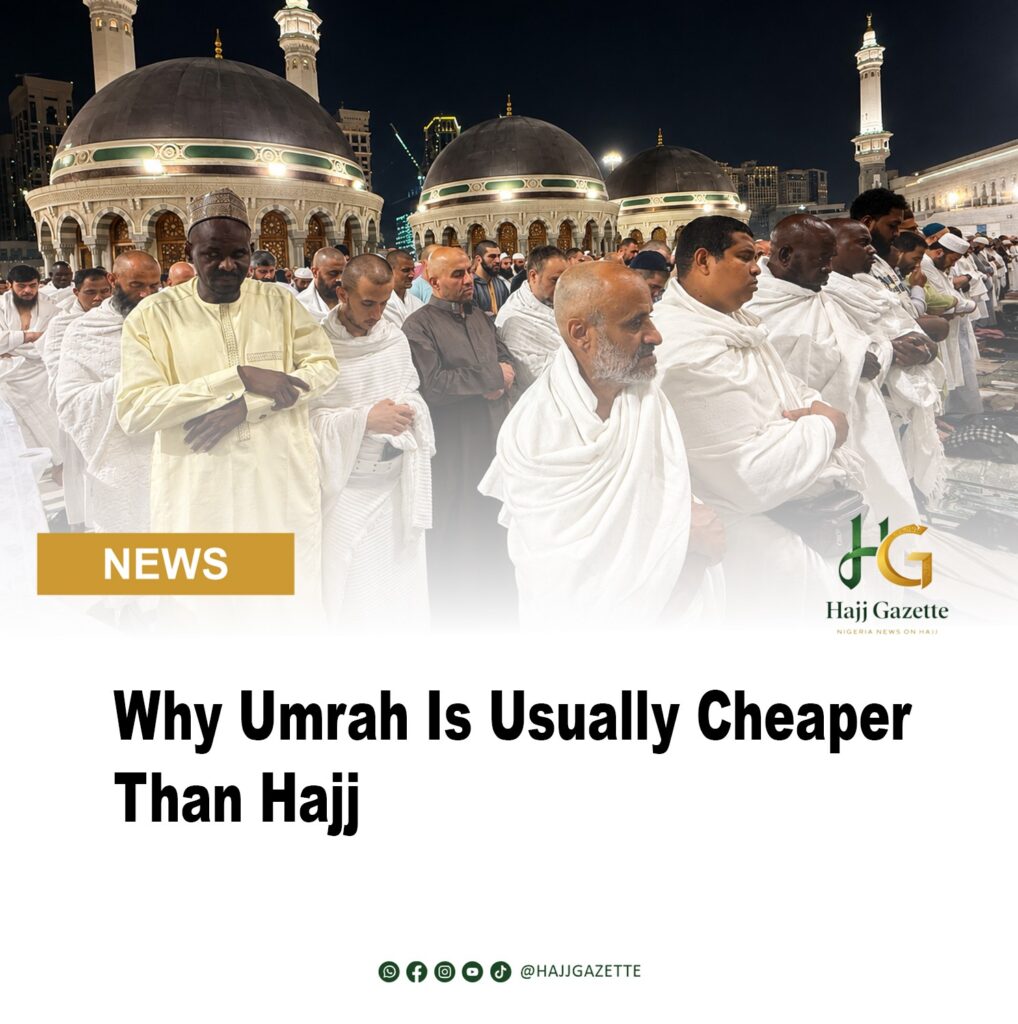
Why Umrah Is Usually Cheaper Than Hajj
The Economics Behind Two Sacred Journeys
By Abdulrazaq Auwal
Behind the apparent price gap lies a complex ecosystem of seasonality, regulation, accommodation, air travel, transportation, quotas and the extraordinary logistics of moving millions of pilgrims.
For many Muslims planning a journey to Saudi Arabia, the cost difference between Hajj and Umrah can appear puzzling. Both involve travel to Makkah, require accommodation, flights and transportation and are deeply significant acts of worship. Yet an Umrah package can often cost substantially less than a Hajj package.
The explanation, however, goes far beyond the number of days spent in Saudi Arabia. The real difference lies in how the two pilgrimages are organised, regulated and delivered at scale. Hajj is a highly concentrated global operation. Umrah is comparatively flexible. That distinction has profound economic consequences.
Hajj Is More Than a Longer Umrah
One of the most common misconceptions is that Hajj costs more simply because it lasts longer. Duration matters, but it is only one component. Hajj brings together millions of pilgrims within a tightly defined period in the Islamic calendar. Their movements are not discretionary. Pilgrims must perform specific rites at specific locations and within prescribed periods.
The result is an extraordinary logistical operation.
Hotels must accommodate huge numbers of visitors. Buses must move pilgrims between locations. Camps and facilities must be prepared. Food must be supplied. Medical teams must be deployed. Security arrangements must be intensified. Flights must operate within carefully coordinated schedules. All of these services must work simultaneously. That concentration of demand is one of the fundamental reasons Hajj costs more.
The Economics of Concentrated Demand
Hajj represents a classic case of demand concentration.
During ordinary periods, Makkah and Madinah accommodate pilgrims and visitors arriving at different times. During Hajj, however, an enormous proportion of the annual pilgrimage demand is compressed into a short operational window. This changes the economics.
Accommodation providers face peak demand. Airlines face increased pressure for limited seats. Ground transportation operators must deploy large fleets. Catering companies must prepare huge quantities of food within strict schedules.
In simple economic terms, when millions of customers require similar services at almost the same time, the cost of delivering those services rises. The pilgrim ultimately carries part of that cost.
Umrah Has One Major Economic Advantage: Flexibility
Umrah operates under a different model.
Pilgrims have considerably greater flexibility over when they travel. Although demand can surge during Ramadan, school holidays and other peak periods, Umrah generally takes place across a much broader portion of the year.
That flexibility gives travellers something Hajj pilgrims have far less of: choice. An Umrah pilgrim can potentially compare airlines, travel during a less expensive period, select accommodation farther from the Haram and adjust the length and quality of the package.
A pilgrim travelling during a peak Umrah period, by contrast, may face prices that approach or even exceed some Hajj-related travel costs. This is an important distinction.
Umrah is not inherently cheap. It is more flexible
And flexibility has economic value.
The Quota Factor
Perhaps the biggest structural difference between the two pilgrimages is the Hajj quota system. Hajj is not an open-ended tourism market in which every willing traveller can simply purchase a place. Countries receive allocations, and national authorities must work within those limits.
Why Umrah Is Usually Cheaper Than Hajj
For Nigerian pilgrims, this means Hajj involves a chain of institutional processes involving registration, documentation, pilgrim data, accommodation, transportation, airlift, medical arrangements and other services. The quota system also means that planning must be completed within strict Saudi timelines.
This creates a very different commercial environment from ordinary Umrah travel. An Umrah operator can generally work with demand that fluctuates throughout the year. Hajj operators and authorities must prepare for a massive, predetermined concentration of pilgrims.
When Every Minute Counts
The Hajj calendar creates another important cost factor: timing.
During Hajj, transportation is not simply about taking a passenger from one city to another. Millions of pilgrims have to move according to a coordinated schedule. The journey from Makkah to Mina, from Mina to Arafat, from Arafat to Muzdalifah and back to Mina is part of a massive logistical choreography.
A delay involving one segment can affect thousands of people. Consequently, Hajj transportation requires substantial planning and capacity. The same principle applies to accommodation and catering. There is little room for improvisation when huge numbers of pilgrims must be served within narrow timeframes.
What Actually Drives the Cost of a Nigerian Hajj Package?
For a Nigerian pilgrim, the advertised Hajj fare is the final product of multiple cost components.
International Airfare: Flying thousands of Nigerian pilgrims to Saudi Arabia requires substantial airline capacity. Airfare is therefore a major component of the overall package. Fuel prices, aircraft availability, exchange rates, airport charges, routing and seasonal demand can all influence the final cost.
Accommodation: Location matters enormously. Accommodation close to the Haram generally commands a premium. Distance, hotel category, room occupancy and length of stay can significantly change the final package price.
Transportation: Pilgrims need transportation between airports, hotels and sacred sites. During Hajj, the transportation requirement becomes significantly more complex because of the movement between Makkah, Mina, Arafat and Muzdalifah.
Feeding: Large-scale pilgrim feeding is another cost centre. Providing meals for thousands of pilgrims requires procurement, preparation, transportation, distribution and quality control.
Sacred-Site Services: Hajj requires arrangements associated with the sacred sites and the Mina-Arafat-Muzdalifah movement. These services do not have an equivalent scale in a conventional Umrah package.
Medical and Welfare Support: Hajj authorities and operators also have to provide systems for medical assistance, pilgrim guidance and welfare support. The larger the pilgrim population, the greater the infrastructure required.
Administrative and Regulatory Costs: Registration, documentation, visa processing, data management and compliance with Saudi requirements add another layer to the overall cost structure.
Hajj Vs Umrah: The Economic Difference
| Factor | Hajj | Umrah |
| Timing | Fixed annual season | Much of the year |
| Demand | Extremely concentrated | More distributed |
| Quota | Nationally regulated | More flexible |
| Sacred-site movement | Extensive | More limited |
| Accommodation | Peak-season pressure | Variable |
| Transportation | Highly intensive | Generally simpler |
| Planning | Months of advance coordination | Comparatively flexible |
| Package flexibility | More limited | Greater |
| Price sensitivity | Strongly affected by peak demand | Highly dependent on season |
The table illustrates why simply comparing the two packages on the basis of duration can produce the wrong conclusion. The underlying service architecture is different.
Ramadan: The Exception That Proves the Rule
There is one important caveat. Umrah prices can rise dramatically during Ramadan. The final ten nights are particularly significant because of the spiritual importance attached to the period and the huge number of Muslims seeking to worship in Makkah and Madinah.
Hotels close to the Haram can command premium prices. Airfares may rise. Accommodation availability can become limited. Suddenly, the economic advantage of Umrah’s flexibility begins to disappear. This demonstrates a fundamental principle of pilgrimage economics: The price of Umrah is heavily influenced by when you travel.
A pilgrim willing to travel during a less congested period may find a significantly cheaper package than one travelling during Ramadan.
The Nigerian Factor
For Nigerian pilgrims, there is another layer to the equation: the exchange rate. Most major components of a pilgrimage package are ultimately linked to costs incurred in Saudi riyals or international currencies. When the naira weakens against the dollar or Saudi riyal, the cost of purchasing foreign services increases for Nigerian operators and pilgrims.
This means that two pilgrimage seasons with similar Saudi prices can produce very different naira-denominated fares. Airfares, hotel contracts, transportation, catering and other services are all exposed to currency movements. Consequently, discussions about Hajj prices in Nigeria cannot be separated from the country’s broader foreign-exchange environment.
Why A Cheap Umrah Package is Not Necessarily a Better Deal
Price alone can be deceptive. Two Umrah packages may have dramatically different prices because they offer dramatically different services. One may place pilgrims within walking distance of the Haram. Another may use accommodation considerably farther away.
One may provide direct transportation. Another may rely on shared transfers. One may offer fewer days. Another may provide a longer stay. The same principle applies to Hajj. A lower advertised price does not automatically mean better value. Pilgrims should examine what is included before comparing prices.
The real question is not “How much does it cost?” but “What am I getting for the money?”
The Future of Pilgrimage Economics
Saudi Arabia’s continuing digitisation of Hajj and Umrah is likely to change the industry further. Digital registration, electronic contracts, integrated service platforms and more sophisticated pilgrim-data management are gradually creating a more structured pilgrimage ecosystem. For operators, this means greater accountability and less room for informal practices.
For pilgrims, the long-term objective should be greater transparency. The evolution of digital systems could eventually allow pilgrims to compare services more effectively, understand what their packages contain and identify the difference between premium and basic offerings.
The industry is moving from a largely traditional travel model towards a more integrated pilgrimage-management ecosystem. That transition could reshape how Nigerians and other international pilgrims purchase Hajj and Umrah services.
The Bottom Line
Umrah is usually cheaper than Hajj not because it is a lesser journey, nor simply because it involves fewer days. It is cheaper largely because the economics of delivering it are less concentrated and more flexible.
Hajj compresses millions of pilgrims into a narrow period and requires an extraordinary level of coordination across accommodation, transportation, catering, healthcare, security and sacred-site services.
Umrah spreads demand across a much wider calendar and gives pilgrims greater freedom to choose their travel dates and service levels. That difference is reflected in the price.
But the comparison also offers a broader lesson for the Nigerian pilgrimage industry. As Saudi Arabia continues to modernise Hajj and Umrah management, the future of pilgrimage will increasingly be shaped not only by religious requirements but also by data, logistics, technology, supply chains, currency movements and service quality.
For the pilgrim, understanding that economic architecture is more than an academic exercise. It can mean the difference between buying a package because it is cheap and choosing one because it represents genuine value.
“Umrah is not inherently cheap. Its greatest economic advantage is flexibility. Hajj, by contrast, is a global operation compressed into a few critical days.”
The price of pilgrimage should never be viewed in isolation. A responsible pilgrim should assess the quality, proximity, duration and scope of services included in any package before making a financial commitment.