
Why the 6th Hajj Conference Matters for Nigeria’s 2027 Pilgrimage
By Abdulrazaq Auwal
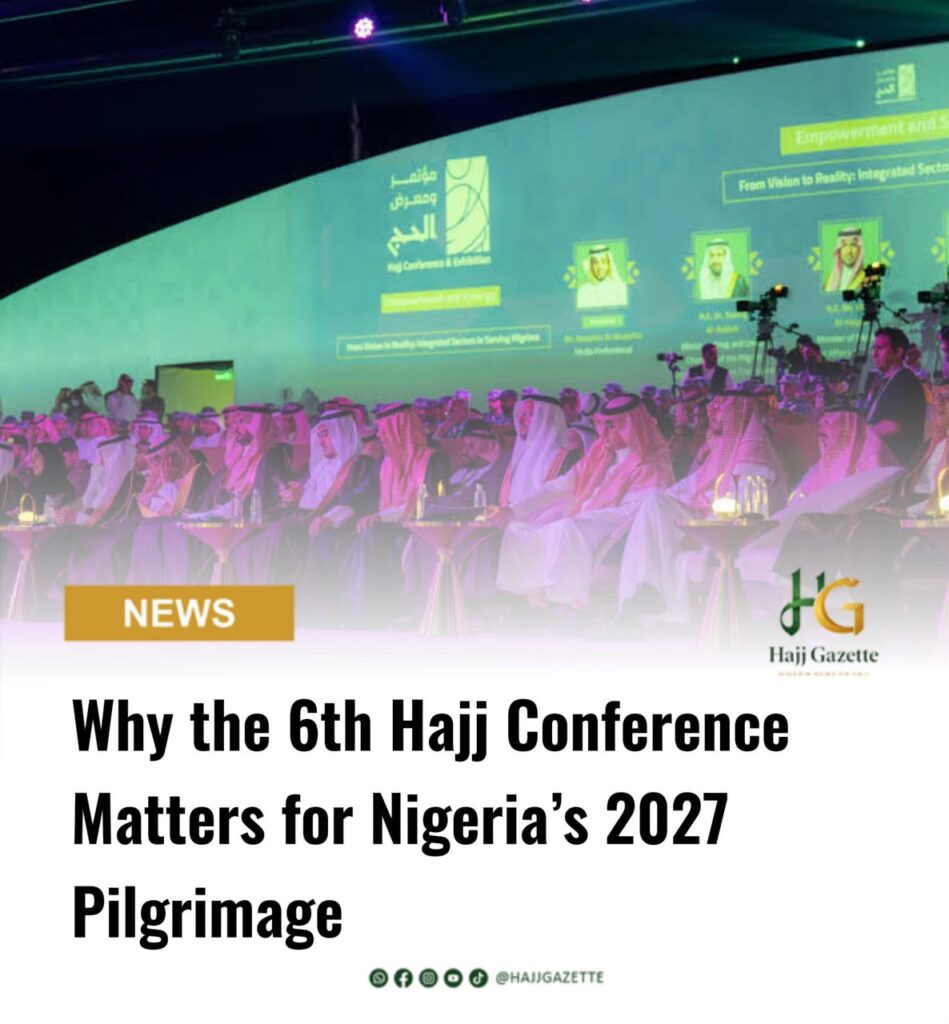
The global Hajj industry will converge in Jeddah from November 8 to 11, 2026, for the Sixth Hajj Conference and Exhibition, bringing together policymakers, government officials, industry leaders, technology providers and service operators from across the world.
Held under the patronage of the Custodian of the Two Holy Mosques and organised by Saudi Arabia’s Ministry of Hajj and Umrah in partnership with the Guests of Allah Service Program, the four-day event is positioned as more than a conventional industry exhibition.
It is becoming an important platform for shaping the future of Hajj.
With Saudi Arabia accelerating the transformation of pilgrimage services under Vision 2030, the conference is expected to place innovation, sustainability, operational efficiency and the quality of the pilgrim experience at the centre of international discussions.
For Nigeria, one of Africa’s major Hajj markets, developments emerging from Jeddah will carry consequences far beyond the conference venue.
The decisions, partnerships and technologies showcased there could influence how Nigerian pilgrims register, pay, travel, receive accommodation and meals as well as moving between the holy sites, access healthcare and other essential services during the 2027 pilgrimage.
A Global Marketplace for the Future of Hajj
The Sixth Hajj Conference and Exhibition is expected to attract participants from more than 95 countries, creating a rare meeting point for governments and private-sector players operating across the Hajj ecosystem.
Its programme will feature ministerial and expert panels, keynote sessions, workshops, innovation showcases, business matchmaking and advisory engagements.
Of particular interest is the conference’s emphasis on practical solutions.
Sessions focusing on crowd operations and hospitality excellence are expected to provide practitioners with new approaches to managing the enormous logistical demands associated with millions of pilgrims.
The innovation zone, meanwhile, will provide space for emerging companies working in areas including mobility, healthcare and hospitality to demonstrate technologies capable of addressing longstanding challenges in pilgrimage management.
For Nigerian stakeholders, this presents an opportunity not merely to observe what Saudi Arabia is doing, but to identify solutions that can be adapted to the Nigerian Hajj environment.
What It Could Mean for Nigeria’s 2027 Hajj
The timing of the conference is particularly significant.
Nigeria’s Hajj 2027 preparations are already moving into a more structured and accelerated phase, with the National Hajj Commission of Nigeria (NAHCON), State Muslim Pilgrims Welfare Boards and private operators working within increasingly demanding Saudi timelines.
Consequently, the Jeddah conference will provide an important opportunity for Nigerian stakeholders to engage directly with Saudi authorities and service providers as preparations for the next pilgrimage intensify.
One of the most important areas will be the broader framework governing Nigeria’s participation in Hajj 2027.
The annual Saudi-Nigeria Hajj arrangements determine critical issues such as pilgrim allocation, operational responsibilities and service requirements. Nigerian officials will therefore have a strong interest in developments surrounding the Kingdom’s preparations and the requirements that will ultimately shape the Nigerian operation.
The Cost Question
Few issues generate as much concern among Nigerian pilgrims as the cost of Hajj.
Accommodation, transportation, catering, aviation and services in the holy sites constitute major components of the final fare paid by pilgrims.
The Jeddah exhibition provides a strategic marketplace where Nigerian stakeholders can interact with Saudi service providers and explore competitive arrangements.
The discussions may cover accommodation in Makkah and Madinah, catering, transportation and services in Mina and Arafat.
For NAHCON and Nigerian operators, the objective should go beyond securing contracts. It should be about obtaining value for money without compromising service quality.
That distinction is increasingly important as Nigerian pilgrims become more demanding about accommodation standards, feeding arrangements, transportation efficiency and overall welfare.
Every reduction in avoidable operational costs can potentially contribute to a more affordable pilgrimage, while every improvement in service quality can directly enhance the pilgrim experience.
The Deadline Revolution
Perhaps the most consequential transformation taking place in the Hajj sector is the shift towards early preparation.
Saudi Arabia is increasingly requiring participating countries and service providers to complete key stages of Hajj planning much earlier than was historically the case.
For Nigeria, this has changed the traditional rhythm of Hajj preparation.
Registration, payments, passport documentation, medical requirements, data verification, accommodation arrangements and other operational processes must increasingly be completed within clearly defined windows.
This means that the era in which pilgrims could delay important preparations until shortly before departure is rapidly disappearing.
The implications are significant.
NAHCON and State Pilgrims Welfare Boards must strengthen public enlightenment, enforce deadlines and improve coordination, while prospective pilgrims must understand that compliance with early timelines is no longer optional.
The 2026 conference could therefore provide additional clarity on the operational expectations that Nigerian stakeholders will need to meet for Hajj 2027.
The Digital Pilgrimage
Technology will be another defining feature of the Jeddah gathering.
Saudi Arabia’s Vision 2030 has placed digital transformation at the heart of its strategy for improving the experience of pilgrims. Data management, electronic registration, digital payments, smart mobility and integrated service platforms are increasingly becoming part of the modern Hajj ecosystem.
For Nigeria, the opportunity is substantial.
The country can leverage partnerships with technology companies and international service providers to strengthen pilgrim management from registration in Nigeria to movement across the holy sites.
Artificial intelligence-powered crowd management, digital identification, smart tracking systems and real-time communication tools could eventually provide Nigerian authorities with better visibility over their pilgrims and enable faster responses when operational challenges emerge.
But technology must not become an end in itself.
Any digital transformation adopted by Nigeria must take into account elderly pilgrims, first-time travellers and people with limited digital literacy.
The objective should be technology that simplifies Hajj, not technology that makes Hajj more complicated.
Preparing for a Changing Hajj Business Model
Another issue that deserves close attention is the evolving role of private-sector operators in the global Hajj industry.
As Saudi Arabia continues to develop a more commercially integrated pilgrimage ecosystem, private companies are playing increasingly important roles in delivering services to pilgrims.
For Nigeria, this raises fundamental questions about the future relationship between government-managed pilgrimage structures, State Pilgrims Welfare Boards and private Hajj operators.
The transition, if it continues, must be carefully managed.
Government institutions have an important responsibility to protect pilgrims, regulate operators and ensure accountability, particularly for pilgrims who may lack the resources or expertise to navigate a complex international travel market.
Why the 6th Hajj Conference Matters for Nigeria’s 2027 Pilgrimage
At the same time, reputable private operators can bring competition, innovation, investment and specialised expertise into the sector.
The challenge for Nigeria is therefore not simply whether the private sector should participate. It is how to create a regulatory framework in which competition improves services while pilgrim protection remains non-negotiable.
An Opportunity for Nigerian Businesses
The conference also offers an opportunity that extends beyond government officials.
Nigeria’s aviation, banking, fintech, hospitality, transportation and technology companies have a potentially significant role to play in the evolving Hajj economy.
The emergence of Hajj-focused technology and service platforms creates opportunities for Nigerian companies to build solutions specifically designed around the needs of Nigerian pilgrims.
A Nigerian fintech company, for example, could develop payment solutions tailored to the long-term savings patterns of prospective pilgrims. Technology companies could develop multilingual communication platforms. Aviation and logistics companies could explore more efficient pilgrimage transportation models.
The goal should be to move Nigeria from being merely a consumer of Hajj services to becoming an active participant in the global Hajj services economy.
From Jeddah to Nigeria
The real measure of the Sixth Hajj Conference will not ultimately be the number of delegates, exhibitors or companies present in Jeddah.
Its significance will be measured by what participating countries take home.
For Nigeria, the priority should be clear: translate international discussions into practical improvements for the Nigerian pilgrim.
That means stronger negotiations, better contracts, more efficient logistics, smarter technology, improved regulation and greater accountability.
It also means ensuring that innovation remains connected to the central purpose of Hajj administration: serving the Guest of Allah.
As Saudi Arabia moves towards its Vision 2030 objectives, the Hajj industry is undergoing one of its most significant transformations in decades.
The Sixth Hajj Conference and Exhibition therefore arrives at a pivotal moment.
For Nigerian stakeholders, Jeddah is not simply another conference destination. It is a strategic window into where the global Hajj industry is heading and an opportunity to ensure that Nigeria is prepared to move with it.