

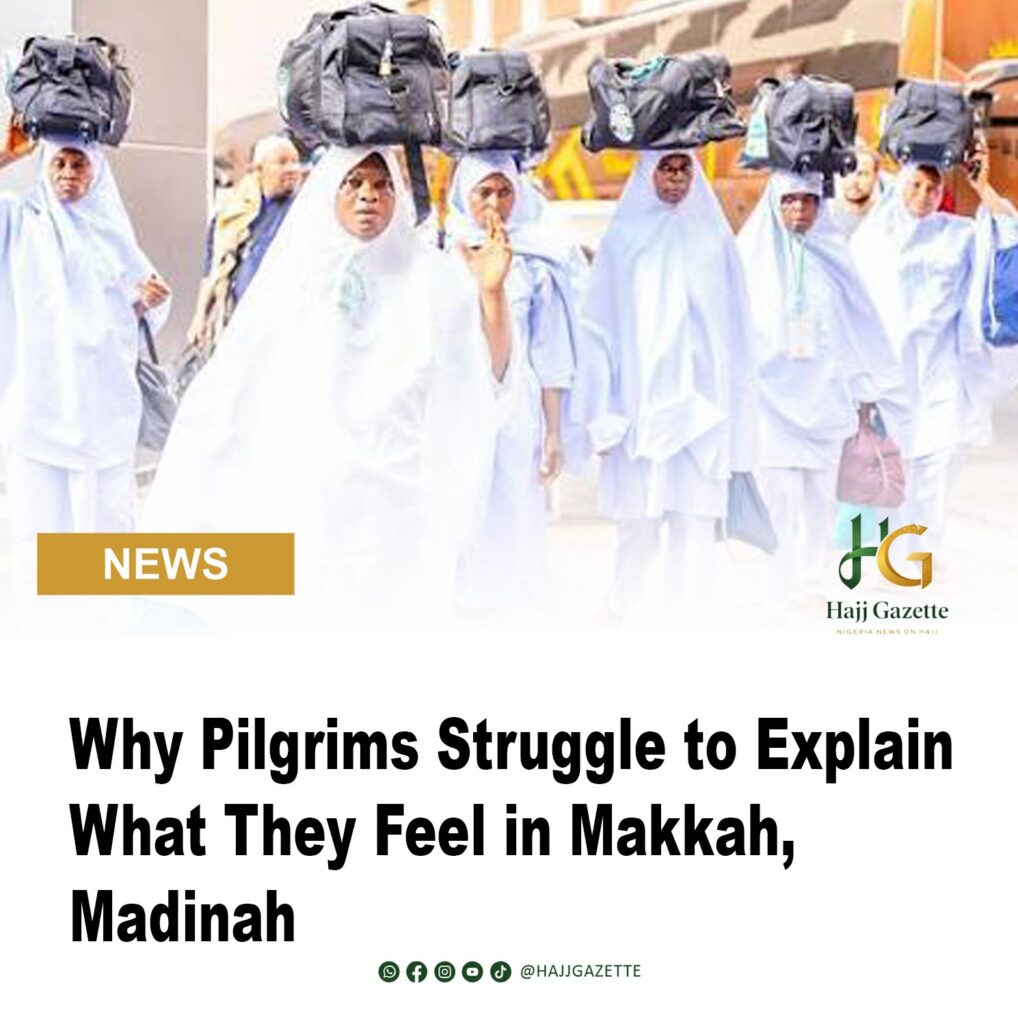
Why Pilgrims Struggle to Explain What They Feel in Makkah, Madinah
By Fa’iza Adamu Musa Dong and Khadija Muhammad Zakari
The first sight of the Kaaba can leave even the most composed pilgrim searching for words.
After years of praying towards it, dreaming about it and hearing its story, the moment finally arrives: the Holy Kaaba is no longer an image on a television screen or a distant object of prayer. It is standing before them.
For some, tears come before words. Others raise their hands in supplication and remain silent, overwhelmed by a mixture of gratitude, awe, humility and disbelief.
For many Muslims, this is the moment when Hajj or Umrah ceases to be a long-awaited journey and becomes a deeply personal encounter with faith.
But the emotions do not begin or end at the Kaaba. They can emerge in the quiet of Madinah, during Tawaf, while listening to the adhan, in moments of private supplication or even on the journey home, when pilgrims suddenly realise they are leaving places they may have spent years longing to see.
That is the paradox of Makkah and Madinah: millions travel thousands of kilometres to reach them, yet once there, many discover that what they experience cannot easily be measured in distance, words or photographs.
A dream that begins long before the journey
For first-time aspirants, the emotional journey can begin years before they ever board a flight.
In Gombe State, Aisha of GRA in Gombe metropolis has long dreamed of standing before the Holy Kaaba.
“Performing Hajj has always been my lifelong dream. Every year I watch pilgrims depart and return with inspiring stories. I pray that Allah grants me the opportunity soon,” she said.
For Abdulrahman Aliyu of Dubai Quarters, financial constraints have delayed his journey, but not his determination.
“I have never been to Hajj, not because I don’t want to, but because I am still saving. I believe that when Allah decrees it, no obstacle can stop me,” he said.
Why Pilgrims Struggle to Explain What They Feel in Makkah, Madinah
Maryam Hussain of Herwagana also in Gombe described Hajj as a dream carried in the heart.
“Hajj is not just a journey; it is a dream that every Muslim carries in the heart,” she said, hoping to one day become “one of His guests in Makkah.”
Their stories reflect the aspirations of countless Muslims who prepare spiritually and financially while waiting for the opportunity to undertake the fifth pillar of Islam.
When the Kaaba finally comes into view
For those who eventually make the journey, the first sight of the Kaaba can become one of the defining moments of the pilgrimage.
Some cry. Others become silent. Some raise their hands in supplication, while others simply stare.
The emotion is not necessarily sadness. For many, it is the culmination of years of prayer, anticipation and longing a mixture of gratitude, awe and humility.
During Tawaf, Sa’i and prayer, those emotions can deepen as pilgrims reflect on their families, personal struggles, mistakes, hopes and mortality.
Away from the routines of ordinary life, the pilgrimage provides time for introspection.
When Better Organisation Creates Room for Worship
For repeat pilgrims, the quality of the physical journey can also influence the spiritual experience.
Nigerians who performed Hajj in both 2025 and 2026 reported improvements in transportation, accommodation, digital coordination, healthcare and communication during the 2026 pilgrimage.
Alhaji Musa Abdullahi of Tumfure community, who participated in both pilgrimages, said movement between the holy sites was smoother in 2026.
“In 2025, we experienced delays while moving between some of the holy sites. This year, transportation was much better organised,” he said.
Hajiya Zainab Muhammad of Liji also noted that digital identification and regular updates made communication easier, while Alhaji Sani Bello cited increased healthcare and emergency support.
Yet pilgrims still encountered challenges, including long walking distances, congestion, inadequate toilet facilities in some areas and occasional delays in meal distribution.
For Alhaji Ibrahim Yusuf, reducing such logistical pressures has a direct spiritual benefit.
“When transportation and accommodation are better, pilgrims have more time to focus on worship instead of worrying about movement,” he said.
Why Madinah feels different
If Makkah often evokes awe, Madinah is frequently described in terms of peace and tenderness.
For visitors to the Prophet’s Mosque, the emotional significance is tied to the life and legacy of Prophet Muhammad ﷺ. Sitting in the mosque, listening to Qur’an recitation or preparing for prayer can become deeply reflective moments.
Some visitors also describe a strange sense of familiarity as though they have returned to somewhere they have never physically visited.
That feeling may be connected to a lifetime of seeing images of the Kaaba and the Prophet’s Mosque, hearing stories of the holy cities and praying towards Makkah.
The places can become familiar in the imagination long before they are experienced physically.
The hardest moment may be leaving
For many pilgrims, however, the most difficult emotion comes at the end.
After days or weeks of worship and reflection, returning home can feel like leaving behind something profoundly meaningful.
A final glance at the Kaaba or departure from Madinah can bring tears and an unsettling question:
“Will I ever come back?” Perhaps that is why pilgrims struggle to explain what they feel in Makkah and Madinah.
The experience differs from person to person. One pilgrim may cry, another may feel an overwhelming sense of peace, while another may simply remain silent.
But for millions, Hajj and Umrah become more than journeys to sacred places.
They become journeys into the heart bringing gratitude, humility, memories, repentance and renewed hope to the surface.
And long after the aircraft lands and the luggage is unpacked, the physical journey may be over, but Makkah and Madinah can remain deeply present in the heart.