

Why a Space Near the Ka’aba Is Often Left Empty During Prayer
By Abdulrazaq Auwal
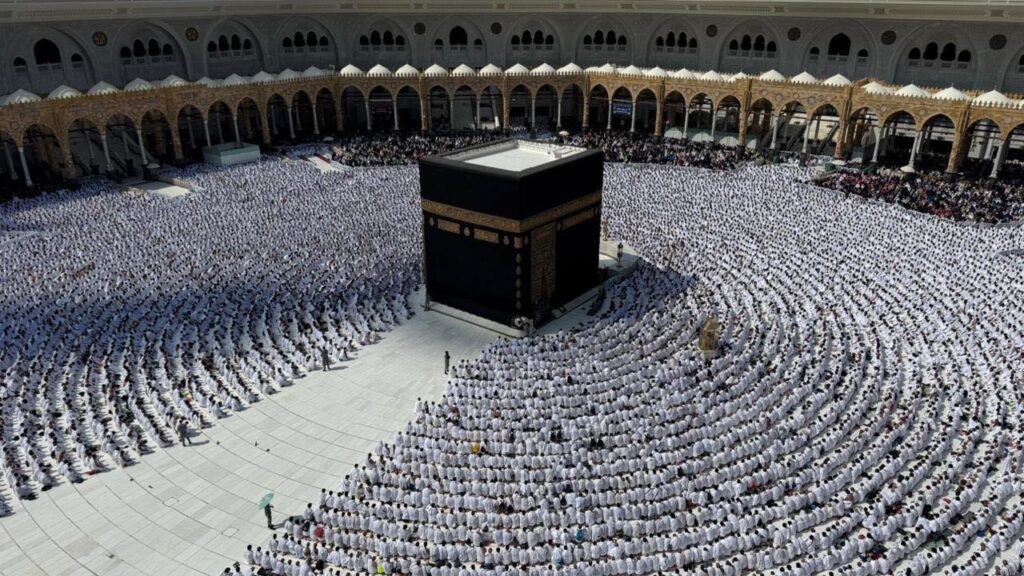
Many pilgrims praying close to the Ka’aba inside Masjid al-Haram occasionally notice something unusual during congregational prayers, a narrow, straight space that is deliberately kept clear of worshippers.
The empty corridor typically appears along the side of the Ka’aba between the Rukn al-Yamani and the Black Stone.
While the mosque is often filled with rows of worshippers stretching across its vast courtyards, this particular line is sometimes left open by security personnel.
READ ALSO: https://hajjgazette.com/pilgrims-applaud-free-luggage-storage-service-at-grand-mosque/
For many pilgrims, the arrangement raises questions. However, the explanation is largely practical and relates to the organisation of congregational prayer around the Ka’aba.
During prayers held in the open area surrounding the Ka’aba, the imam leads from a designated position aligned in that direction.
Maintaining a clear corridor helps ensure that worshippers do not unintentionally form prayer rows ahead of the imam’s position.
In Islamic congregational prayer, it is essential that the imam stands in front while the congregation lines up behind him.
If someone were to stand ahead of the imam while performing the prayer, the alignment of the congregation could be disrupted.
To prevent this situation, security personnel stationed around the Ka’aba sometimes maintain a narrow open path along that section of the mataf area.
Their role is to guide worshippers and ensure the prayer rows remain properly organised during salah.
The practice also reflects the broader crowd-management measures implemented inside Masjid al-Haram, where millions of pilgrims and visitors gather throughout the year, particularly during Ramadan and the annual Hajj pilgrimage.
Despite the effort to keep the corridor open, the arrangement is not always maintained. During peak periods, especially when the mosque reaches full capacity the space may be filled as worshippers occupy every available area to join the congregational prayer.
In such situations, the priority shifts to accommodating the large number of worshippers present within the mosque.
For many visitors, the empty corridor remains one of the small but intriguing operational details inside Masjid al-Haram, an example of the careful planning required to manage prayer arrangements in the world’s largest and most visited mosque.
It is a subtle feature that many pilgrims pass by without noticing, yet it plays a quiet role in maintaining order around Islam’s most sacred site.