

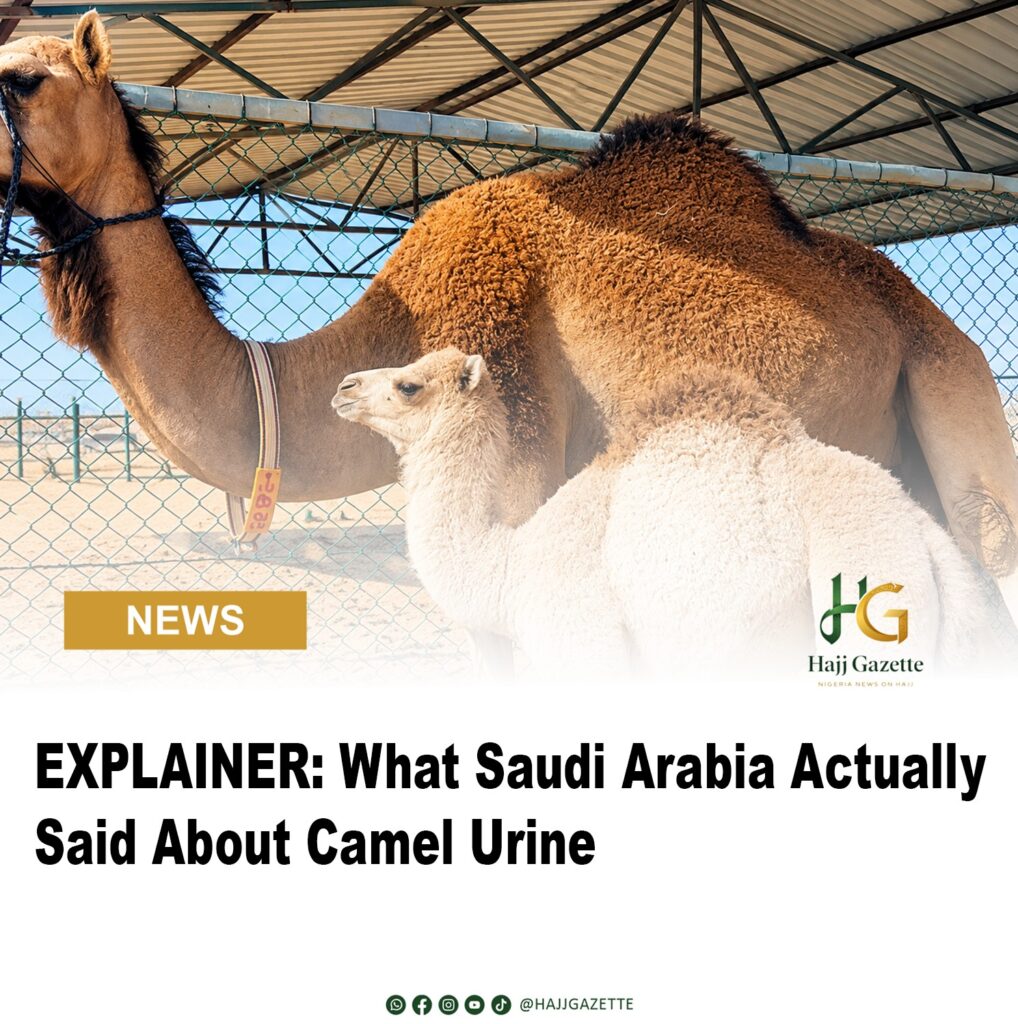
EXPLAINER: What Saudi Arabia Actually Said About Camel Urine and Cancer
By Abdulrazaq Auwal
Saudi Arabia has denied approving a camel urine-based product for cancer treatment, clarifying that it is registered only as a dietary supplement containing vitamins and minerals.
A claim circulating on social media that Saudi Arabia approved a camel urine-based medicine to treat cancer has prompted a clarification from the Saudi Food and Drug Authority (SFDA).
But what exactly did the authority say, what is the product approved for, and is there scientific evidence that camel urine can cure cancer?
Here is what to know: What happened?
The SFDA issued a clarification on its official X account, denying claims that it had approved a camel urine-based product as a cancer treatment.
The authority said the product is registered as a dietary supplement intended to provide vitamins and minerals to meet daily nutritional requirements.
It stressed that the product has no authorised therapeutic claims and has not been approved to treat or cure cancer, including advanced stages of the disease.
The clarification means that registration of the product as a supplement should not be interpreted as approval for cancer treatment.
Did Saudi Arabia approve camel urine as medicine?
No. According to the SFDA’s clarification, the product’s registration is limited to its classification as a dietary supplement.
This distinction is important because registration for use as a supplement does not establish that a product has been demonstrated to treat a disease.
EXPLAINER: What Saudi Arabia Actually Said About Camel Urine
Claims that the authority approved camel urine as a cancer medicine therefore misrepresent the product’s stated regulatory status.
Can camel urine treat cancer?
There is no established clinical evidence that camel urine is a safe and effective treatment for cancer in humans.
Although camel urine has featured in traditional remedies and has been investigated in some laboratory research, preliminary findings do not establish that it can treat cancer in patients.
Cancer treatment requires evidence from appropriately designed clinical studies demonstrating that a treatment is effective and sufficiently safe. Camel urine has not met that standard as an established cancer therapy.
The takeaway
The central issue is not that Saudi Arabia approved a camel urine cancer medicine. Rather, the SFDA clarified that the product in question is registered as a dietary supplement and has no authorised cancer-treatment claims.
The distinction matters because a product’s registration does not automatically mean it has been proven to cure disease.
In the case of cancer, treatment decisions should be guided by qualified medical professionals and reliable clinical evidence.