

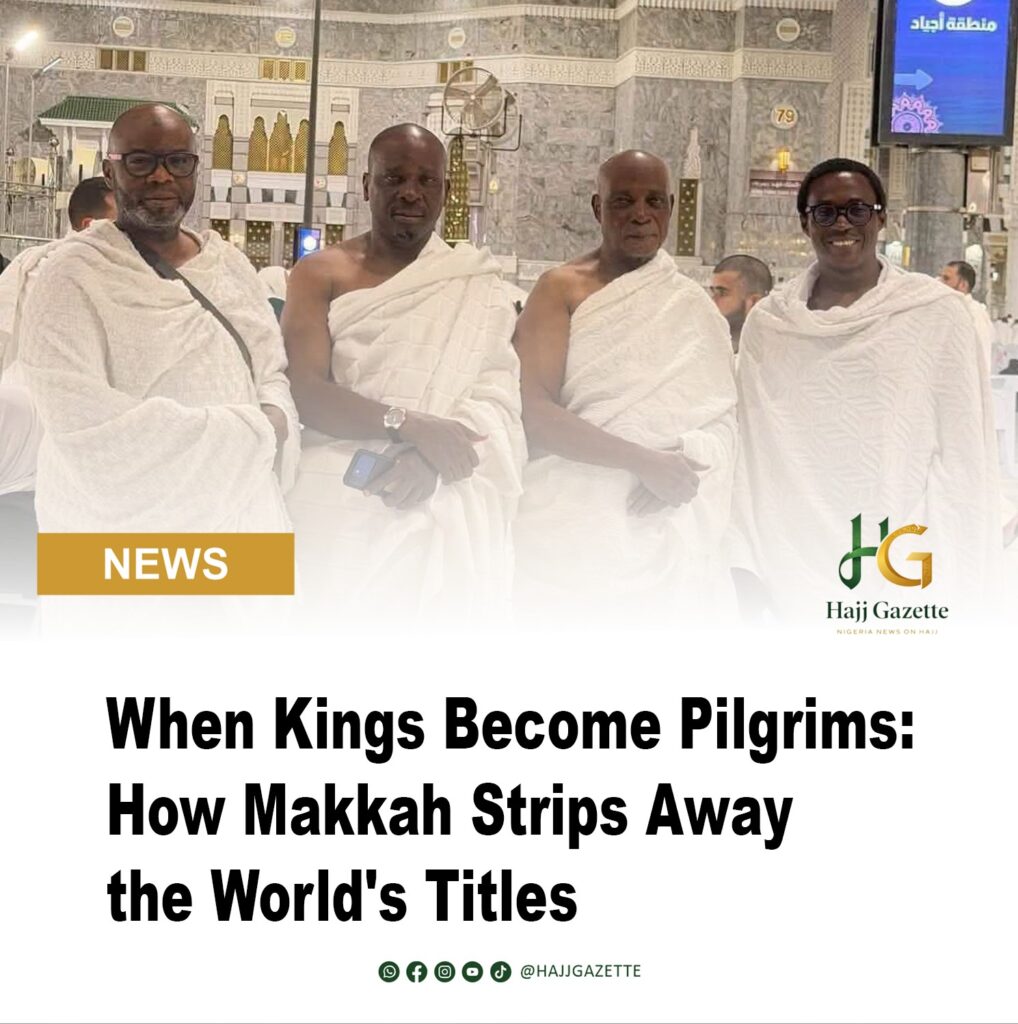
When Kings Become Pilgrims: How Makkah Strips Away the World’s Titles
By Abdulrazaq Auwal Mungadi
The photographs of the Olubadan of Ibadanland, Oba Rashidi Ladoja, performing Umrah in Makkah recently triggered a debate on social media, with some X users questioning the absence of his traditional crown and his appearance with an uncovered head.
For those accustomed to seeing the Olubadan in the elaborate symbols of traditional authority, the sight of a monarch without his crown may appear unusual.
But in Makkah, the absence of the crown tells a much bigger story.
It is a story about what happens when kings, presidents, billionaires, scholars, politicians and ordinary workers enter a sacred state in which worldly distinctions are deliberately pushed into the background.
For a male pilgrim, entering ihram means leaving behind much of the clothing and appearance associated with everyday life. The Saudi Ministry of Hajj and Umrah describes the ihram garments as the izar and rida, and notes that men stand equal in their clothing and appearance, without distinction based on colours or possessions.
The transformation is striking.
A monarch accustomed to royal robes appears in the same basic attire as a farmer. A wealthy businessman who may travel in luxury stands beside a labourer. A senior government official joins the same procession as an ordinary citizen.
There are no royal robes in the tawaf. No presidential uniform. No corporate suit. No military insignia. No designer display.
The pilgrimage does not erase who these people are outside Makkah. The king remains a king. The businessman remains wealthy. The official retains his office.
But the rituals of pilgrimage remove the visual language through which society ordinarily communicates hierarchy. That is one of the profound messages embedded in ihram.
When Kings Become Pilgrims: How Makkah Strips Away the World’s Titles
The crown controversy surrounding the Olubadan therefore raises a question that goes beyond traditional Yoruba customs: what happens to the symbols of earthly authority when a ruler enters a ritual in which every male pilgrim is required to observe the same essential restrictions?
Islamic jurisprudence places specific restrictions on male pilgrims in ihram, including the prohibition against wearing headgear. The uncovered head, therefore, is not necessarily a rejection of royalty or culture. Within the context of ihram, it can represent obedience to the requirements of the pilgrimage.
This creates an intriguing meeting point between culture and religion.
Traditional institutions use crowns, robes, staffs and other regalia to communicate authority, history and identity. Ihram, by contrast, communicates submission, humility and equality before Allah. Makkah brings these two worlds into sharp contrast.
The same principle becomes even more visible during the major rites of Hajj. Millions gather from different countries, languages, races and social backgrounds, yet the central rituals demand a shared form of worship.
The spectacle is powerful precisely because of what is absent. No one can buy a higher station before Allah through wealth. A person’s political office does not give him a privileged form of ihram. A royal title does not create a separate tawaf.
The palace is left behind. So is the boardroom, the government office and the public stage. For a brief period, the language of status gives way to the language of worship.
And perhaps that is one of Makkah’s most enduring lessons: before Allah, the crown may identify a king in the world, but it does not make him a greater servant.
In Makkah, kings become pilgrims and pilgrims stand together.