

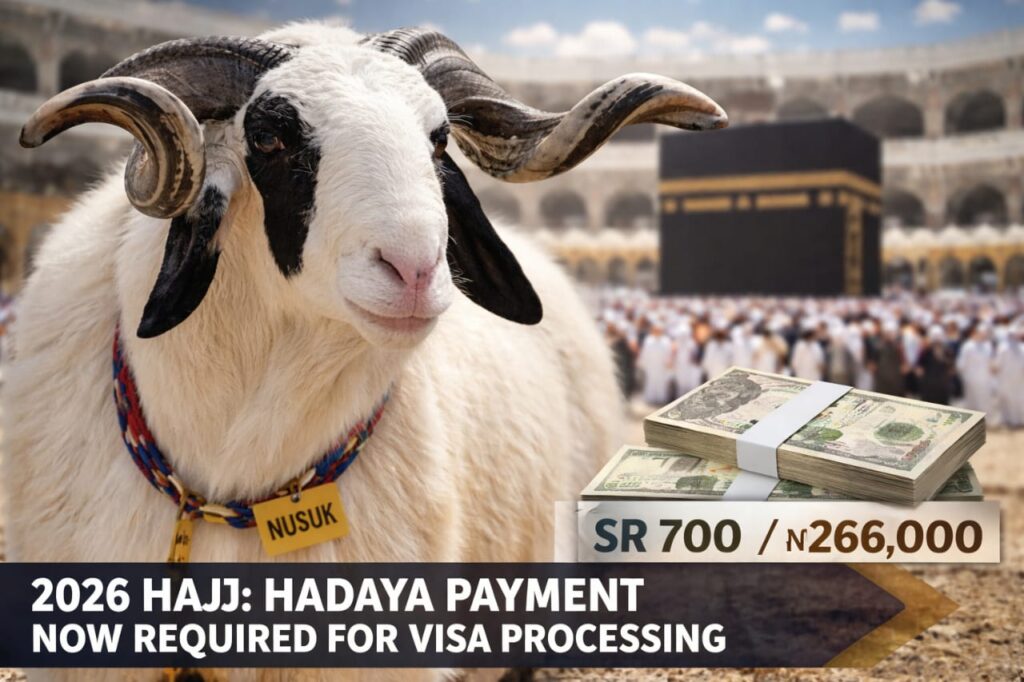
2026 Hajj: Hadaya Payment Now Required for Visa Processing
By Abdulrazaq Auwal
The Ministry of Hajj and Umrah has made payment for Hadaya a mandatory requirement for visa processing for pilgrims performing specific categories of the pilgrimage in the 2026 Hajj exercise.
The directive was reiterated during a virtual meeting with Hajj-participating countries held on February 4, 2026, to review the Official Schedule of Operations and re-emphasize compliance with operational requirements on the Nusuk Masar registration platform ahead of the visa processing phase.
During the meeting, the Director of the Department of International Cooperation at the ministry, Abdallah Awad Alshehri, stressed that all pilgrims intending to perform Hajj under the categories known as Tumattu’i and Qiran must have their Hadaya processed and paid for through the Nusuk Masar portal before their visas can be issued.
He explained that pilgrims who choose these categories are required to perform animal sacrifice as part of the Hajj rites, except those who opt to observe fasting as an alternative.
The Hadaya payment has been fixed at about 700 Saudi Riyals, which is approximately ₦266,000, and must be processed strictly through the Nusuk Masar platform. The ministry emphasized that the centralized digital payment system is designed to eliminate the long-standing practice of purchasing sacrificial animals through informal or black-market channels during the pilgrimage.
As a result, participating countries were required to clearly indicate the number of pilgrims performing the three Hajj categories; Ifrad, Tumattu’i and Qiran, while also identifying those who will fast instead of performing the sacrificial rite.
In addition to Hadaya payment, Saudi authorities outlined other conditions that must be fulfilled before visa approval.
These include the payment of a consolidated guarantee for all pilgrims and the completion of medical service contracts with accredited healthcare providers domiciled in Saudi Arabia through the Nusuk Masar portal.
The ministry further introduced a new requirement mandating each participating country to secure backup accommodation in Makkah equivalent to one percent of its total pilgrims’ quota.
The additional accommodation is intended to serve as a contingency measure in case of unforeseen circumstances during the pilgrimage.
Meanwhile, the National Hajj Commission of Nigeria disclosed that during the February meeting, discussions with Saudi authorities also focused on improving the Umrah visa experience and addressing cases of visa violations and overstays in the Kingdom.
Saudi officials also informed Nigerian authorities that the Bilateral Air Service Agreement (BASA) passenger-sharing formula between the two countries will be fully implemented beginning from the 2027 Hajj season.
However, for the 2026 Hajj exercise, the Kingdom has agreed to maintain the existing concessionary 40/60 airlift arrangement between Nigerian and Saudi carriers.
Tour operators were then advised to strengthen monitoring mechanisms to ensure that their pilgrims comply with visa conditions and return to their home countries within the approved validity period.