

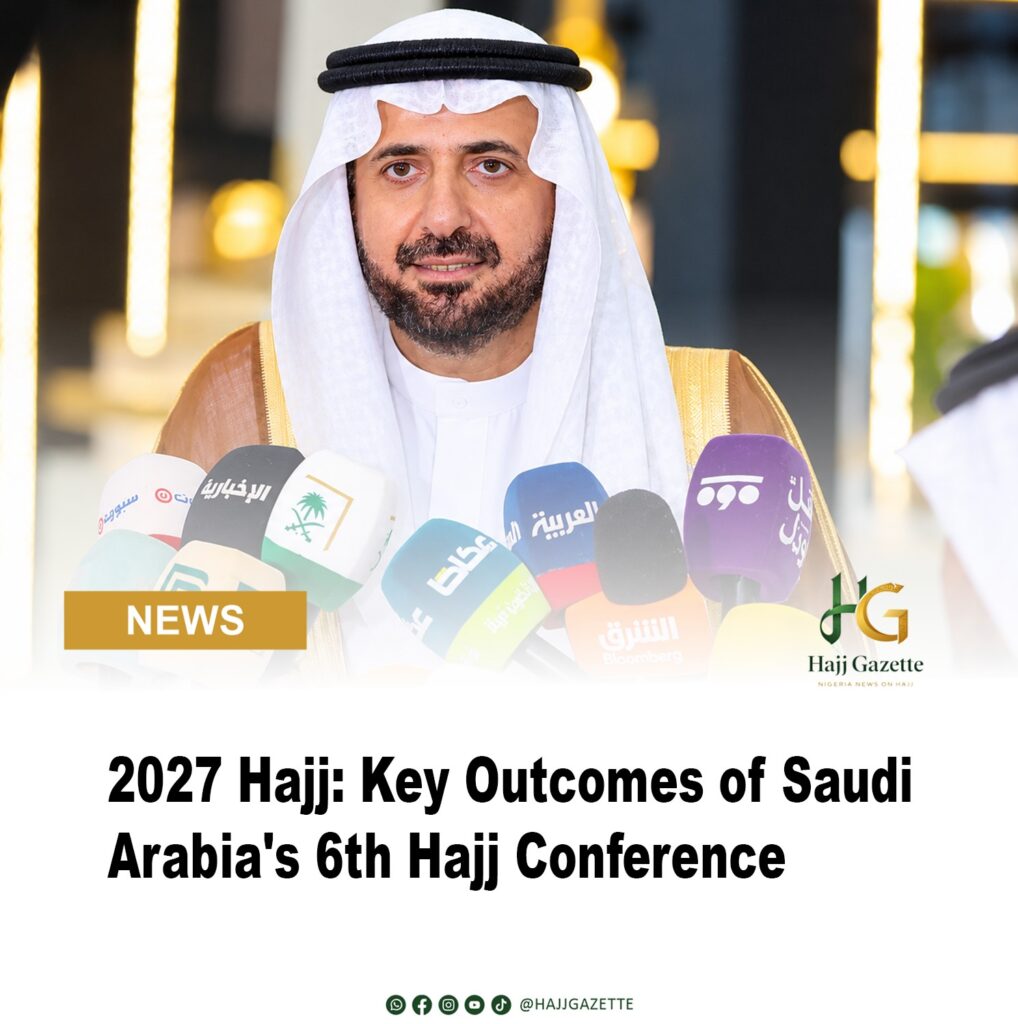
2027 Hajj: Key Outcomes of Saudi Arabia’s 6th Hajj Conference
By Abdulrazaq Auwal
Saudi Arabia has outlined major developments in Hajj administration, pilgrim services, infrastructure and technological innovation ahead of the 2027 Hajj season, following the conclusion of the 6th Hajj Conference and Exhibition in Jeddah.
The four-day event, held from November 8 to 11, 2026, at the Jeddah Superdome under the theme “From Makkah to the World,” brought together government officials, Hajj service providers, international delegations, technology companies and other stakeholders from across the world.
The conference focused on strengthening international cooperation, improving pilgrims’ experiences and advancing operational preparations through early contracting, digital transformation and expanded service delivery.
Expansion of Global Hajj Services
One of the major developments announced at the conference was the expansion of Saudi Arabia’s international Hajj service network.
The Kingdom increased the number of licensed service providers for international pilgrims to 34 companies, while expanding direct contracting arrangements across 58 countries.
The Direct Hajj Programme was also extended to 75 additional countries, providing more international pilgrims with access to the programme.
The conference further provided a platform for governments, airlines, accommodation providers and Hajj missions from 78 countries to engage in operational discussions and conclude service agreements ahead of the 2027 pilgrimage.
2027 Hajj: Key Outcomes of Saudi Arabia’s 6th Hajj Conference
The early contracting arrangements will help participating countries coordinate their preparations and organise transportation, accommodation and other essential services for pilgrims well ahead of the 2027 Hajj season.
Artificial Intelligence (AI) and Digital Transformation
Technological innovation was another major focus, with the exhibition showcasing artificial intelligence-powered solutions designed to improve pilgrims’ experiences.
Among the innovations were multilingual interactive robots capable of responding to enquiries, providing directions and assisting pilgrims around the clock.
The technologies were presented as potential tools for improving information delivery, reception services, navigation and operational coordination.
Dedicated innovation zones and hackathons also brought technology companies and service providers together to develop digital solutions for crowd management, logistics and access to pilgrimage services.
Accommodation and Pilgrim Welfare
The conference also highlighted improvements in accommodation infrastructure in Makkah and Madinah.
2027 Hajj: Key Outcomes of Saudi Arabia’s 6th Hajj Conference
Saudi Minister of Tourism, Ahmed Al-Khateeb, disclosed that approximately 4,000 accommodation buildings had been licensed in the two holy cities, providing more than 1.3 million beds.
The ministry is also working to improve accommodation standards by reducing the number of beds in individual rooms and encouraging the development of permanent accommodation facilities across different budget categories.
The developments will help the Kingdom accommodate more pilgrims and improve their overall experience.
Growth in Umrah Arrivals and Pilgrim Satisfaction
Figures presented during the conference also highlighted the growth of international Umrah activities.
International Umrah arrivals increased from 8.4 million in 2022 to approximately 18 million in 2025, reflecting the continued expansion of the Kingdom’s pilgrimage sector.
Saudi Arabia recorded a 93 per cent pilgrim satisfaction rate, surpassing the 90 per cent target set under its Vision 2030 programme.
Airport Capacity and Security Coordination
Transportation infrastructure and security preparedness also featured prominently in discussions.
King Abdulaziz International Airport in Jeddah handled approximately 52 million passengers in 2025, underscoring its importance in receiving international travellers, including Hajj and Umrah pilgrims.
Meanwhile, Saudi Public Security officials said authorities had identified and mapped more than 900 potential risks and developed proactive response plans to address them as part of efforts to strengthen operational coordination and risk management.
2027 Hajj: Key Outcomes of Saudi Arabia’s 6th Hajj Conference
The approach reflects the Kingdom’s emphasis on improving coordination among agencies responsible for pilgrim safety, crowd management and the delivery of essential services.
Minister Highlights Fivefold Growth in Conference Participation
In his closing remarks, Saudi Minister of Hajj and Umrah, Dr. Tawfiq Al-Rabiah, highlighted the significant growth in participation and international interest in the Hajj Conference and Exhibition.
Al-Rabiah disclosed that participating entities had increased from 84 in 2022 to approximately 520 in the sixth edition, representing more than fivefold growth.
He said the event attracted participants from more than 150 countries, including leaders, ministers and muftis, and projected that visitor numbers would exceed 200,000 by its conclusion.
According to the minister, the figures reflect the conference’s growing international profile and increasing engagement of governments and organisations through contracts and partnerships aimed at improving services for pilgrims and advancing the Hajj ecosystem.
He also expressed appreciation to the Saudi leadership for its patronage and continued support, describing it as a cornerstone of the Kingdom’s efforts to enhance services for Hajj and Umrah pilgrims.
Implications for the 2027 Hajj
The outcomes of the 6th Hajj Conference and Exhibition point to an increasingly coordinated approach to managing the annual pilgrimage, with greater emphasis on early preparations, international partnerships, technology and improved infrastructure.
For international Hajj missions, including Nigeria’s National Hajj Commission (NAHCON), the expanded service network and early contracting arrangements provide important opportunities to engage service providers, assess available options and strengthen preparations for their respective pilgrims.
The growing adoption of digital solutions also presents opportunities for Hajj authorities to improve pilgrims’ education, information dissemination, movement coordination and access to essential services.
As preparations for the 2027 Hajj gather momentum, the conference has provided an important platform for strengthening cooperation between Saudi authorities and international stakeholders, with the ultimate objective of delivering safer, more efficient and better-organised pilgrimage services.