

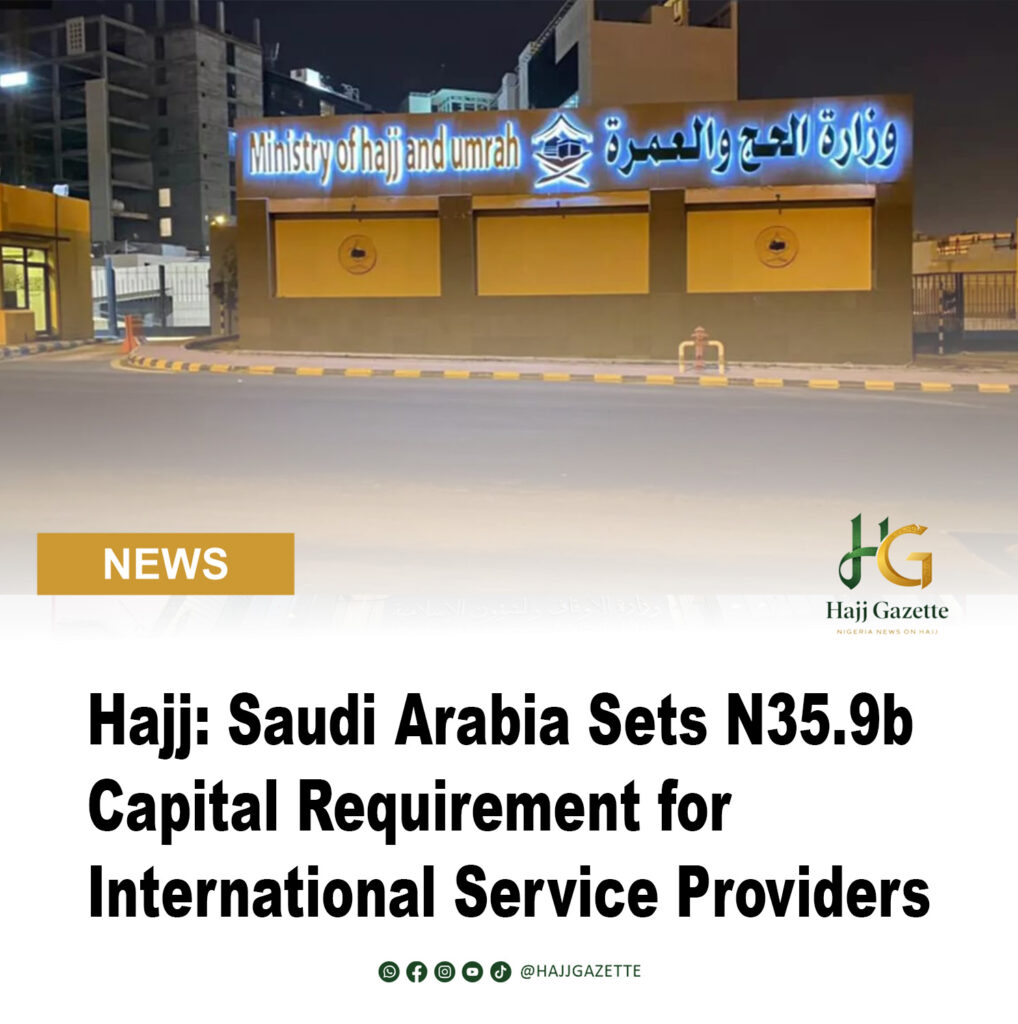
Hajj: Saudi Arabia Sets N35.9b Capital Requirement for International Service Providers
By Abdulrazaq Auwal
Saudi Arabia’s Ministry of Hajj and Umrah has stipulated a minimum capital requirement of 100 million Saudi riyals, equivalent to approximately N35.9 billion, for companies seeking licences to provide services to international Hajj pilgrims.
The requirement forms part of a set of financial, operational and regulatory conditions published by the ministry on its official website for companies seeking licences to serve pilgrims arriving from outside the Kingdom.
The ministry also requires applicant companies to have total assets of at least SAR250 million, equivalent to approximately N89.7 billion.
In addition, companies must demonstrate sound financial standing, with accumulated losses not exceeding their capital, supported by their latest financial statements.
The licensing framework identifies two categories of eligible applicants: companies licensed by the Saudi Ministry of Tourism to operate tourism activities and companies licensed by one of the country’s national airlines.
Beyond meeting the basic eligibility conditions, applicants will undergo a performance-based assessment covering their corporate experience, operational capacity, regulatory compliance and financial strength.
For companies operating tourism accommodation facilities, the assessment allocates 40 points to financial capacity, 30 points to regulatory compliance, 20 points to operational capacity and 10 points to company experience and customer satisfaction.
The financial assessment will consider indicators such as cash ratios, quick ratios and debt ratios, while operational capacity will be evaluated based on the availability of approved internal regulations, organisational structures and management systems.
Other requirements include documented procedures for selecting service providers, managing contracts, evaluating performance, handling customer complaints and managing operational risks.
The framework also takes into account regulatory violations recorded against tourism accommodation facilities during the preceding three years.
Such violations include breaches of tourism regulations, civil defence and safety requirements, municipal regulations and other applicable regulatory provisions.
For airline companies seeking licences, the assessment similarly covers experience, operational capacity, regulatory compliance and financial strength, with particular attention to violations recorded by the General Authority of Civil Aviation during the preceding three years.
The document sets out a 100-point evaluation framework for both categories of applicants, with financial capacity and regulatory compliance carrying significant weight in the assessment of tourism companies.
The requirements underscore the ministry’s emphasis on the financial stability, institutional capacity and regulatory track record of companies seeking to participate in providing services to international Hajj pilgrims.